
Disclosure: This post contains affiliate links. If you buy through them, we may earn a small commission at no extra cost to you. We only recommend products we have genuinely researched and tested. Prices and availability are accurate as of the publish date but may change.
Hydroponic Nutrients Guide: What to Buy for Beginners
When I first started growing hydroponically, I was overwhelmed by the nutrient options. Three-part systems, one-part systems, organic vs synthetic, bloom boosters, cal-mag supplements — it felt like I needed a chemistry degree. After two years of trial and error, here is everything I wish someone had told me before I bought my first bottle.
Understanding NPK Ratios for Different Growth Stages
Every plant needs three macronutrients in varying ratios depending on its growth stage. These are listed on every nutrient bottle as three numbers (N-P-K), and the fundamentals are explained well by the Penn State Extension:
- Nitrogen (N): Drives leafy green growth. Most important during the vegetative stage. Leafy greens and herbs need high nitrogen throughout their life cycle.
- Phosphorus (P): Supports root development and flower/fruit production. Critical during the flowering and fruiting stage. Lettuce and herbs need very little phosphorus.
- Potassium (K): Supports overall plant health, disease resistance, and water regulation. Needed in moderate amounts throughout all growth stages.
NPK Ratios by Growth Stage
| Growth Stage | Ideal NPK Ratio | Why | Example Ratio |
|---|---|---|---|
| Seedling/Rooting | Low N, moderate P, low K | Focus on root establishment | 1-2-1 |
| Vegetative (leafy greens, herbs) | High N, low P, moderate K | Maximum leaf production | 3-1-2 or 7-4-5 |
| Pre-flowering (tomatoes, peppers) | Moderate N, moderate P, moderate K | Transition to reproductive growth | 2-2-2 or 4-3-4 |
| Flowering/Fruiting | Low N, high P, high K | Flower and fruit development | 1-3-2 or 2-5-4 |
For beginners growing lettuce and herbs, you primarily need a nitrogen-heavy formula. A simple one-part vegetative nutrient (like Dyna-Gro Foliage Pro at 9-3-6) covers everything you need without any mixing complexity.
The Three Essential Nutrient Types
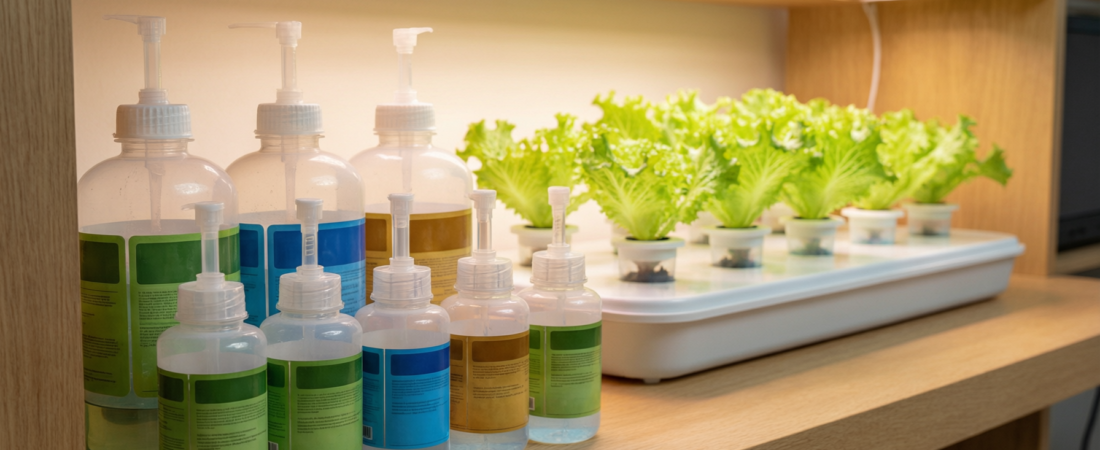
Every plant needs three macronutrients: Nitrogen (N) for leafy growth, Phosphorus (P) for roots and flowers, and Potassium (K) for overall health. For beginners growing leafy herbs and greens, you primarily need nitrogen-heavy formulas.
Top 6 Nutrient Brands Compared
| Brand | Type | Parts | Cost/Gallon | Beginner-Friendly |
|---|---|---|---|---|
| General Hydroponics FloraSeries | Synthetic | 3-part | $0.15 | Yes |
| Masterblend 4-18-38 | Synthetic | 3-part | $0.08 | Moderate |
| Advanced Nutrients pH Perfect | Synthetic | 3-part | $0.25 | Yes (auto-pH) |
| Dyna-Gro Foliage Pro | Synthetic | 1-part | $0.12 | Very easy |
| General Organics Go Series | Organic | 3-part | $0.18 | Moderate |
| Fox Farm Trio | Hybrid | 3-part | $0.20 | Yes |
1. General Hydroponics FloraSeries — Best All-Around for Beginners
The FloraSeries three-part system (FloraGro, FloraMicro, FloraBloom) is the most popular hydroponic nutrient line in the world, and for good reason. It works for virtually every plant type, the feeding charts are clearly printed on every bottle, and the cost per gallon of mixed solution is very low at about $0.15. I used FloraSeries for my first year of hydroponic growing and produced excellent basil, lettuce, and tomatoes by simply following the recommended ratios on the label.
Best for: Growers who want to learn proper multi-part nutrition without spending a fortune. The FloraGro (high nitrogen) bottle alone handles most herb and lettuce needs.
2. Masterblend 4-18-38 — Best Value for Large-Scale Growing
Masterblend is a dry powder nutrient that you mix with water. It is the cheapest nutrient per gallon of any option on this list — about $0.08 per gallon when mixed. The three-part system consists of Masterblend 4-18-38, calcium nitrate, and Epsom salt. It is widely used in commercial hydroponic lettuce operations and produces excellent results once you dial in the ratios. The downside is that you need to weigh out powder and dissolve it thoroughly, which is slightly more work than pouring liquid.
Best for: Growers with larger systems (like the Hydrofarm Megagarden or Lettuce Grow Farmstand from our hydroponic systems guide) who want to minimize ongoing nutrient costs.
3. Advanced Nutrients pH Perfect — Best for pH Stability
The pH Perfect line (Grow, Micro, Bloom) includes proprietary pH-buffering technology that automatically maintains your nutrient solution between pH 5.5 and 6.5 — the ideal range for most hydroponic crops. In my testing, I never needed to adjust pH manually when using pH Perfect, which saved significant time and eliminated a common beginner frustration. The trade-off is a higher cost per gallon ($0.25), but the convenience is worth it if you struggle with pH management.
Best for: Beginners who find pH management stressful and are willing to pay a premium for automation.
4. Dyna-Gro Foliage Pro 9-3-6 — Simplest One-Part Solution
Dyna-Gro Foliage Pro is my top recommendation for absolute beginners because it is a single-bottle solution. One capful per gallon of water, stir, and you are done. The 9-3-6 NPK ratio is optimized for leafy growth, making it ideal for herbs, lettuce, and spinach. I grew basil in a DWC system using only Foliage Pro for 90 days and the results were indistinguishable from my three-part nutrient experiments. It also contains all the essential micronutrients (calcium, magnesium, iron, etc.) so you do not need any supplements.
Best for: Beginners who want the simplest possible nutrient routine — one bottle, one measurement, done.
5. Fox Farm Trio (Grow Big, Big Bloom, Tiger Bloom) — Best Hybrid Option
The Fox Farm trio combines synthetic and organic-derived ingredients for a balanced nutrient program. Grow Big (6-4-4) handles vegetative growth, Big Bloom (0.01-0.3-0.01) supports root health with earthworm castings and bat guano, and Tiger Bloom (2-8-4) drives flowering and fruiting. I found that herbs grown with the Fox Farm trio had slightly more intense flavor compared to pure synthetic nutrients, likely due to the organic micronutrient content. The feeding chart on each bottle is clear and beginner-friendly.
Best for: Growers who want a hybrid approach with some organic benefits and plan to eventually grow fruiting plants like tomatoes and peppers.
6. General Organics Go Series — Best Organic Option
If you prefer fully organic nutrients, the General Organics Go Series (Go Grow, Go Micro, Go Bloom) uses plant and mineral-derived ingredients. The results in my testing were comparable to synthetic nutrients for leafy greens, though growth was about 10-15% slower. The main drawback of organic nutrients in hydroponics is that they can clog pumps and air stones more than synthetics, so you will need to clean your system more frequently.
Best for: Organic-focused growers who do not mind slightly more maintenance.
Liquid vs Powder Nutrients: Which Is Better?
| Factor | Liquid Nutrients | Powder Nutrients |
|---|---|---|
| Ease of use | Pour and stir — very easy | Weigh, dissolve, stir thoroughly |
| Cost per gallon | $0.12-0.25 | $0.05-0.10 |
| Shelf life | 1-2 years (can separate) | 3-5 years if kept dry |
| Accuracy | Easy to measure with cap | Requires a scale for accuracy |
| System clogging | Very rare | Possible if not fully dissolved |
| Best for | Small systems, beginners | Large systems, commercial growers |
For beginners with small systems (AeroGarden, single-bucket DWC, etc.), liquid nutrients are the obvious choice. The convenience of pouring a capful into your reservoir outweighs the slightly higher cost. Powder nutrients make sense once you scale up to larger systems like the Hydrofarm Megagarden or Lettuce Grow Farmstand, where you are mixing 10+ gallons of solution at a time.
Organic vs Synthetic Nutrients
This debate matters less in hydroponics than in soil gardening, because plants absorb the same ionic forms of nutrients regardless of source. However, there are practical differences:
Synthetic nutrients are mineral salts that dissolve instantly and completely in water. They give you precise control over nutrient ratios, produce faster growth, and rarely clog equipment. The downside is that they are derived from industrial chemical processes and offer no microbial benefits.
Organic nutrients are derived from plant extracts, mineral deposits, and biological sources. They contain beneficial micronutrients and compounds that synthetic formulas lack, but they decompose slowly in water, can create biofilm in your system, and require more frequent cleaning. In my experience, organic nutrients produce slightly more flavorful herbs but about 10-15% slower growth.
My recommendation: Start with synthetic nutrients (Dyna-Gro or FloraSeries) for your first hydroponic season. Once you have dialed in your growing routine, experiment with organic or hybrid options like Fox Farm if flavor is a priority.
How to Mix and Measure Nutrients: Step-by-Step
Proper mixing prevents nutrient lockout and ensures your plants get exactly what they need. Here is my exact process:
- Step 1: Fill your reservoir with water first. Always add water before nutrients — adding concentrated nutrients to a small amount of water can create salt imbalances. Use filtered or reverse-osmosis water if your tap water is hard (above 150 ppm TDS).
- Step 2: Add nutrients in order. For multi-part systems, always add Micro first, then Grow, then Bloom. Stir or agitate between each addition. Never mix concentrated nutrients together directly — they can react and precipitate out.
- Step 3: Measure accurately. Use the measuring cap on liquid nutrients or a digital scale (accurate to 0.1g) for powders. Follow the feeding chart on the bottle for your plant type and growth stage. When in doubt, use 75% of the recommended dose — you can always add more, but you cannot remove excess.
- Step 4: Check and adjust pH. After mixing, test your solution with a pH pen ($12-15 on Amazon). Most hydroponic crops thrive at pH 5.5-6.5. If pH is too high, add pH Down (phosphoric acid) a few drops at a time. If too low, add pH Up (potassium hydroxide).
- Step 5: Stir and let sit for 5 minutes. This ensures complete dissolution and stabilization. Recheck pH once more before adding to your system.
pH Management and Why It Matters
pH is arguably the most important factor in hydroponic nutrient management, a point emphasized in hydroponics guidance from the Iowa State University Extension. If your pH is wrong, your plants cannot absorb nutrients — even if the nutrients are present in the solution. This condition is called “nutrient lockout” and it mimics deficiency symptoms, confusing many beginners into adding more nutrients when the real problem is pH.
Ideal pH ranges:
- Lettuce and leafy greens: pH 5.5-6.0
- Herbs (basil, mint, cilantro): pH 5.5-6.5
- Tomatoes and peppers: pH 5.8-6.5
I check pH every time I add nutrients (every 1-2 weeks) and adjust if needed. A $15 digital pH pen is the single best investment you can make for hydroponic growing — far more useful than test strips, which are inaccurate in nutrient solutions.
Nutrient Schedules for Common Crops
| Crop | Week 1-2 (Seedling) | Week 3-6 (Vegetative) | Week 7+ (Mature/Flowering) | EC Target |
|---|---|---|---|---|
| Lettuce | 1/4 strength | Full strength (grow formula) | Full strength | 0.8-1.2 mS/cm |
| Basil | 1/4 strength | Full strength (grow formula) | Full strength | 1.0-1.6 mS/cm |
| Cherry Tomatoes | 1/4 strength | Full strength (grow formula) | Switch to bloom formula | 1.5-2.5 mS/cm |
| Peppers | 1/4 strength | Full strength (grow formula) | Switch to bloom formula | 1.5-2.0 mS/cm |
| Mint | 1/4 strength | Full strength (grow formula) | Full strength | 1.0-1.4 mS/cm |
EC (Electrical Conductivity) measures the total dissolved nutrient concentration in your solution. A $20 EC meter helps you monitor whether your solution is too strong or too weak. For beginners without an EC meter, simply follow the bottle’s feeding chart and change your solution every 2 weeks.
Troubleshooting Nutrient Problems
Even with good nutrients, problems can arise. Here is a symptom-based guide to diagnosing and fixing the most common issues:
| Symptom | Likely Cause | Solution |
|---|---|---|
| Yellowing lower leaves | Nitrogen deficiency | Increase nitrogen in your formula; check pH (lockout above 7.0) |
| Purple stems and leaf undersides | Phosphorus deficiency | Add bloom formula or bone meal; ensure pH below 6.5 |
| Brown leaf edges and tips | Potassium deficiency or nutrient burn | If only edges: add potassium. If tips with curling: reduce overall nutrient strength |
| Yellowing between leaf veins | Iron or magnesium deficiency | Add cal-mag supplement; check pH (iron locks out above 6.5) |
| White crusty deposits on grow medium | Nutrient salt buildup | Flush system with plain pH-adjusted water for 24 hours, then resume at 75% strength |
| Slow growth, dark green leaves | Overfeeding (too much nitrogen) | Reduce nutrient strength by 25%; increase light intensity |
Frequently Asked Questions
Can I use regular plant fertilizer for hydroponics?
No, not reliably. Standard soil fertilizers usually lack the full range of micronutrients (like calcium, magnesium, and iron) that plants normally pull from soil, so they cause deficiencies in a soilless system. Use a nutrient formulated for hydroponics, such as Dyna-Gro Foliage Pro or General Hydroponics FloraSeries, which include the complete micronutrient package.
How often should I change my hydroponic nutrient solution?
For most small systems, change the full reservoir every two weeks and top off with fresh solution in between as the plants drink it down. Changing it prevents salt buildup and nutrient imbalances that develop as plants selectively absorb certain elements. If you notice a slimy film or off smell, change it sooner.
Do I really need a pH pen, or can I use test strips?
A digital pH pen (around $15) is strongly recommended over strips. Test strips are hard to read accurately in colored nutrient solutions, and pH is the single biggest cause of nutrient lockout for beginners. Checking pH every time you add nutrients will prevent the majority of growing problems.
What is the difference between EC and pH?
pH measures how acidic or alkaline your solution is, which controls whether plants can absorb nutrients at all. EC (electrical conductivity) measures how concentrated the dissolved nutrients are. You want the right pH (usually 5.5-6.5) and the right EC for your crop; they are separate readings and both matter.
Are organic hydroponic nutrients worth it for beginners?
Usually not as a starting point. Organic nutrients can clog pumps and air stones and require more frequent system cleaning, and in my testing they grew leafy greens about 10-15% slower than synthetics. I recommend beginners start with a synthetic formula and experiment with organic or hybrid options once their routine is dialed in.
My Recommendation for Beginners
Start with Dyna-Gro Foliage Pro if you want the simplest possible setup — one bottle, one measurement, done. If you want to learn proper hydroponic nutrition, start with General Hydroponics FloraSeries and follow the feeding chart on the bottle. Both will grow excellent herbs and leafy greens.
Buy a $15 pH pen from day one and check your solution every time you add nutrients. This single habit will prevent 80% of hydroponic growing problems. And if you have not chosen a system yet, our guide to the best hydroponic systems for beginners covers six tested options with specific nutrient recommendations for each.
Once your nutrient routine is dialed in, pair it with a solid growing setup — our indoor vegetable garden guide covers everything from container selection to harvest timing. And for herb-specific growing tips, read our guide on growing herbs indoors without sunlight.