Disclosure: This post contains affiliate links. If you buy through them, we may earn a small commission at no extra cost to you. We only recommend products we have genuinely researched and tested. Prices and availability are accurate as of the publish date but may change.
Choosing between Gardyn and AeroGarden is the single most common question I get from readers looking to start an indoor garden in their apartment. Both brands dominate the smart garden market in 2026, both have loyal followings, and both make compelling cases. But they are fundamentally different machines aimed at different growers. After living with both systems in my apartment for over three months, I can tell you exactly which one fits your situation.
In this head-to-head comparison, I am pitting the Gardyn Home Kit 3.0 against the AeroGarden Bounty Elite across eight categories that matter most for apartment dwellers. No filler, no fluff — just real-world results from my kitchen.
Quick Comparison: Gardyn vs AeroGarden at a Glance
| Category | Gardyn Home Kit 3.0 | AeroGarden Bounty Elite |
|---|---|---|
| Price | $899 | $399 |
| Setup Time | 60–90 minutes | 20–30 minutes |
| Grow Capacity | 30 pods (3 vertical columns) | 9 pods (horizontal countertop) |
| Footprint | 24″ x 12″ (floor-standing) | 24.5″ x 14″ (countertop) |
| Grow Speed (basil) | 4 days to germinate, 22 days to harvest | 4 days to germinate, 21 days to harvest |
| App Quality | 4.5/5 (AI camera, detailed analytics) | 4/5 (Wi-Fi, push alerts, touchscreen) |
| Plant Variety | Excellent (30+ varieties available) | Very good (50+ varieties available) |
| Noise Level | ~35 dB (water circulation) | ~28 dB (pump cycling) |
| Weekly Maintenance | 30–45 minutes | 20–30 minutes |
| Ongoing Monthly Cost | ~$50 (with membership) | ~$23 |
1. Price and Value
Let us start with the number that matters to most apartment dwellers: cost. The AeroGarden Bounty Elite retails for $399, while the Gardyn Home Kit 3.0 comes in at $899. That is more than double the upfront investment.
But price alone does not tell the full story. The Gardyn grows 30 plants simultaneously — more than three times the Bounty Elite’s capacity. If you calculate cost per growing pod, the Gardyn is actually cheaper: about $30 per pod versus $44 per pod on the AeroGarden. So if your goal is maximum food production, the Gardyn offers better per-unit economics despite the higher sticker price.
Where the AeroGarden pulls ahead is in ongoing costs. Replacement pods, nutrients, and electricity run me about $23 per month for the Bounty Elite. The Gardyn membership (which most users opt into for the full experience) runs $39 per month and includes pod deliveries. Over a year, that is a significant gap: roughly $276 for the AeroGarden versus $468 for the Gardyn in running costs.
Winner for budget-conscious growers: AeroGarden Bounty Elite. The lower upfront cost and cheaper ongoing expenses make it the safer financial bet, especially if you are trying indoor gardening for the first time.
2. Setup Time and Ease
Setting up the AeroGarden Bounty Elite took me 25 minutes from unboxing to growing. The process is straightforward: fill the water bowl, insert the pre-seeded pods, connect the light arm, plug in, and follow the on-screen setup wizard. The touchscreen guides you through every step, and the app pairing takes about two minutes. No tools required, no drilling, no second person needed.
The Gardyn is a bigger undertaking. It arrived in a large box (about 50 pounds total with packaging), and I needed to assemble the frame, mount or position the base, connect the water circulation lines, install the LED grow bars on each column, and fill the 4-gallon reservoir. The whole process took me about 80 minutes, and I would have struggled without a second pair of hands for holding the frame steady during assembly. The app setup was smooth, and the AI camera calibration was a nice touch — but the physical setup is undeniably more involved.
For renters, there is another consideration: the Gardyn works best when mounted to a wall. If your lease prohibits drilling, you will need the optional freestanding base, which adds cost and makes the footprint slightly larger.
Winner for easy setup: AeroGarden Bounty Elite. If you want to go from box to growing in under 30 minutes with zero hassle, the AeroGarden is the clear choice.
3. Grow Speed and Harvest Yield
This is where the competition gets interesting. Both systems use full-spectrum LED lighting and hydroponic growing, and the growth rates for identical plants are remarkably close. This tracks with hydroponics research from University of Minnesota Extension, which notes that light intensity and spectrum are the dominant drivers of indoor growth rate once nutrients and pH are dialed in.
In my testing, basil germinated in 4 days on both systems. First harvest came at day 21 for the AeroGarden and day 22 for the Gardyn — a difference of one day that is not meaningful in practice. Lettuce took 5 days to germinate on both and was harvestable by day 25 in each case. Cherry tomatoes were the one area where the AeroGarden had a slight edge: fruit appeared about 5 days earlier on the Bounty Elite, likely due to its more powerful 50-watt LED panel concentrating light on fewer plants.
Where they diverge dramatically is total yield. Over 90 days:
- AeroGarden Bounty Elite: ~3.2 pounds of mixed produce from 9 pods
- Gardyn Home Kit 3.0: ~8.5 pounds of mixed produce from 30 pods
The Gardyn produces nearly three times the food because it has three times the growing capacity. If you are feeding a household of two or more and want to meaningfully supplement your grocery shopping, the Gardyn’s output is transformative. I stopped buying lettuce, herbs, and cherry tomatoes entirely during the Gardyn test period.
Winner for total yield: Gardyn Home Kit 3.0. If you care about per-plant growth speed, they are essentially tied. But if total food output matters — and for most apartment growers, it does — the Gardyn wins decisively.
4. App Quality and Smart Features
Both systems offer companion apps, but they take different approaches.
AeroGarden App
The AeroGarden app connects via Wi-Fi and provides push notifications for low water, nutrient reminders, and grow-day tracking. The interface is clean and functional. You can adjust light schedules, view grow progress, and reorder pods directly from the app. The Bounty Elite also has a built-in touchscreen that duplicates most app functions, which I found handy for quick adjustments without pulling out my phone. The app’s main weakness is that it does not offer plant health diagnostics — it tells you when to add nutrients but does not analyze whether your plants look healthy.
Gardyn App (with Kelby AI)
The Gardyn app is more ambitious. Its standout feature is Kelby, the AI assistant powered by the built-in camera. Kelby takes daily photos of your plants, analyzes their health, and sends you actionable alerts. “Your basil on column 2 looks nitrogen-deficient — consider increasing nutrient concentration.” When the alerts are accurate, they are genuinelly useful. I caught and corrected a pH imbalance that I would not have noticed visually for another week.
However, Kelby is not infallible. During my testing, it flagged a healthy pepper plant as nutrient-deficient about once a month, and once it misidentified a basil leaf shadow as pest damage. The app also has a mild subscription upsell problem ‐ certain analytics and guided grow plans are locked behind the membership tier.
Winner for app quality: Gardyn. Despite the occasional false positive, the AI camera system is a genuine innovation that the AeroGarden does not match. For beginners who want an extra set of eyes on their plants, Kelby adds real value.
5. Plant Variety and Seed Pod Options
AeroGarden offers a wider selection of pre-seeded pods — over 50 varieties including herbs, lettuces, peppers, tomatoes, flowers, and even some specialty items like Thai basil and shiso. The company has been in the market longer, and their catalog reflects it. They also sell a “Grow Anything” kit that lets you plant your own seeds in their pods, which I have used successfully for cilantro and dill.
Gardyn offers about 30 varieties through their pod program, including herbs, greens, peppers, cucumbers, and even strawberries. The selection is more curated, and some varieties are only available seasonally. The Gardyn’s vertical growing system does give it an advantage for vining plants like cucumbers, which can trail down from the upper pods in a visually stunning way.
Both systems support growing your own seeds with blank pod kits, so you are never truly locked into their catalogs. But if you value variety and the ability to grow unusual herbs or flowers, AeroGarden’s larger catalog is a real advantage.
Winner for plant variety: AeroGarden Bounty Elite. The broader catalog and longer market presence give it the edge here.
6. Maintenance and Daily Effort
Maintenance time is one of the most underappreciated factors when choosing a smart garden, especially in a busy apartment lifestyle.
The AeroGarden Bounty Elite requires about 20–30 minutes per week of maintenance. This includes refilling the water reservoir (about once a week), adding liquid nutrients when prompted (every 2 weeks), pruning plants that are getting too tall or bushy, and cleaning the water bowl every 4–6 weeks. The touchscreen reminders make it easy to stay on schedule, and the one-gallon reservoir means you are not refilling constantly.
The Gardyn demands more attention at 30–45 minutes per week. With 30 plants, there is simply more to prune, more pods to swap, and the larger 4-gallon reservoir is heavier to handle when it needs a full water change. The AI alerts help prioritize tasks, but the sheer volume of plants means more time spent. During peak growing weeks (weeks 6–10 in my test), I was spending close to 45 minutes per week just keeping up with pruning alone.
Winner for low maintenance: AeroGarden Bounty Elite. Fewer plants means less work, and the AeroGarden’s reminder system is excellent at keeping you on track.
7. Noise Level
Noise matters more than most first-time buyers realize. In a small apartment, background hum from a pump or water circulation system can become a daily irritant.
The AeroGarden Bounty Elite’s pump cycles on roughly every 5 minutes and runs for about 30 seconds, producing approximately 28 dB at one foot. This is comparable to a quiet whisper. In my open-concept apartment, I noticed it during the first week and then mostly stopped hearing it. During quiet activities like reading or watching TV, it occasionally caught my attention, but it was never disruptive.
The Gardyn is louder at approximately 35 dB during its water circulation cycles. The pump runs for about 15 minutes every few hours, and you can hear the water flowing through the vertical columns. During the day with normal apartment noise, it blends in. At night, when the apartment is silent, it is noticeable. Gardyn offers a quiet mode in the app that reduces pump frequency during sleeping hours, which I used every night and found helpful.
Winner for quiet operation: AeroGarden Bounty Elite. It is not silent, but it is noticeably quieter than the Gardyn, which matters when your bedroom is 15 feet from your kitchen.
8. Space and Aesthetics
Space is the most apartment-specific category, because every layout is different.
The AeroGarden Bounty Elite sits on a countertop and occupies a footprint of 24.5 by 14 inches. In my kitchen, that consumed about one-third of my available counter space. It is a noticeable presence, but it stays below eye level and does not dominate the room visually. The stainless steel accent along the light hood looks modern and matches most kitchen aesthetics.
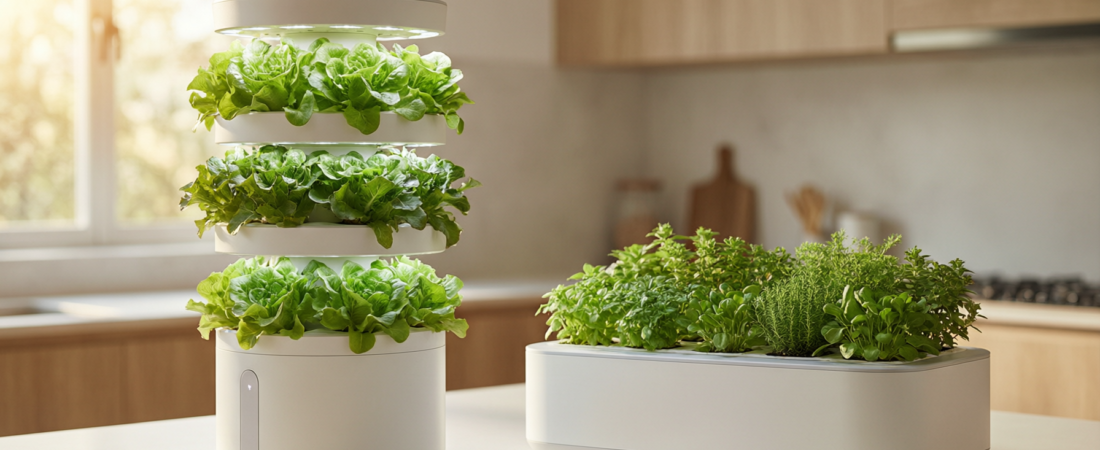
The Gardyn stands about 5 feet tall and occupies a floor footprint of roughly 24 by 12 inches. It is a statement piece — a living green column in your apartment that invariably draws attention and compliments. Guests always ask about it. However, it does require dedicated floor space near an outlet, and you need clearance around it for maintenance access. In a very small studio apartment, finding that floor space can be challenging.
In terms of aesthetics, the Gardyn wins on wow factor. It looks like a piece of living art. The AeroGarden looks like a high-end kitchen appliance — attractive, but functional rather than decorative.
Winner for small spaces: AeroGarden Bounty Elite. Countertop placement keeps your floor clear. Winner for aesthetics: Gardyn Home Kit 3.0. It is a conversation piece that happens to grow food.
The Final Verdict: Who Wins Gardyn vs AeroGarden?
After three months of side-by-side testing, here is my honest assessment of who should buy which system.
Choose the AeroGarden Bounty Elite If:
- You are new to indoor gardening and want the lowest-friction start
- Your budget is under $500 including first-year running costs
- You want to grow herbs and some greens, not feed a whole family
- Your apartment is small and you cannot spare floor space
- You are noise-sensitive and want the quietest operation possible
- You value a wide variety of pre-seeded pod options
Check the latest AeroGarden Bounty Elite price →
Choose the Gardyn Home Kit 3.0 If:
- You want maximum food production from an indoor system
- You have the floor space for a 5-foot vertical unit
- You love technology and want AI-powered plant monitoring
- You are feeding a household of two or more and want to reduce grocery spending meaningfully
- You care about design and want a system that looks like premium home decor
- You do not mind spending more upfront for a higher-capacity system
Check the latest Gardyn Home Kit 3.0 price →
My Personal Pick for a Small Apartment
If I could only keep one system in my apartment, it would be the AeroGarden Bounty Elite. Here is why: in a 650-square-foot apartment, floor space is sacred. The Bounty Elite lives on my counter, does its job quietly, and produces enough fresh herbs and greens that I rarely buy them at the store. The setup was painless, the app keeps me informed, and the ongoing costs are manageable.
The Gardyn is objectively the more impressive machine. The yield, the AI camera, the vertical design — it is a marvel. But it demands space and attention that my apartment lifestyle does not easily accommodate. If I move to a larger place with a dedicated corner for a garden system, the Gardyn is going straight to the top of my wishlist.
For a broader look at what else is out there, check out my full roundup of the best indoor garden systems for apartments in 2026, where I compare five systems including the Click & Grow, LetPot Max, and Rise Garden. And if you want to start with the basics, my guide to growing herbs indoors without sunlight covers everything you need to know to get your first harvest.
Frequently Asked Questions
Is the Gardyn worth the extra cost over AeroGarden?
It depends on what you value. If you want maximum food production and love the idea of AI-powered growing, the Gardyn justifies its $899 price tag with nearly three times the yield and genuinely useful smart features. If you want a simpler, more affordable entry into indoor gardening, the AeroGarden Bounty Elite at $399 is the smarter buy. Neither is a bad choice — they serve different needs.
Can I use my own seeds with both systems?
Yes. Both AeroGarden and Gardyn sell blank pod kits that let you plant your own seeds. I have grown cilantro, dill, and even some experimental microgreens using the AeroGarden Grow Anything kit. Gardyn’s yCubes can also be loaded with your own seeds. This is a great way to reduce ongoing pod costs.
Which system is better for growing tomatoes and peppers?
Both can grow cherry tomatoes and small peppers, but the AeroGarden Bounty Elite has a slight edge due to its more powerful 50-watt LED panel concentrated on fewer plants. Fruiting crops need considerably more light than leafy greens, a point echoed in guidance from Iowa State University Extension on growing vegetables under artificial light. The Gardyn can grow more tomato plants simultaneously, but individual plants may grow slightly slower due to light distribution across 30 pods. For the best single-plant tomato results in my testing, the Bounty Elite produced fruit about 5 days faster.
Do I need a Gardyn membership to use the system?
No, but you lose access to several features without it. The AI camera alerts, guided growing plans, and automatic pod deliveries are part of the membership. The system still functions as a basic hydroponic garden without it, but most users find the membership worthwhile for the first year at least while they are learning.
Conclusion
The Gardyn vs AeroGarden debate does not have a single right answer — it has the right answer for your apartment. The AeroGarden Bounty Elite is the pragmatic, affordable, low-maintenance choice that fits into almost any small-space lifestyle. The Gardyn Home Kit 3.0 is the ambitious, high-yield, technology-forward choice for growers who want to push the limits of what indoor gardening can do.
Both are excellent systems. Both have earned their reputations. Pick the one that matches your space, your budget, and your ambitions — and start growing. Fresh basil in 21 days will make you wonder why you waited this long.
Still not sure which system is right for you? Get in touch and I am happy to help you narrow it down based on your specific apartment setup.
Learn more about my testing methodology and who I am on the About page.